
Is This Really the Best Plot for Your Sitcom Pilot?
Making sure your sitcom pilot script isn't Dead on Arrival

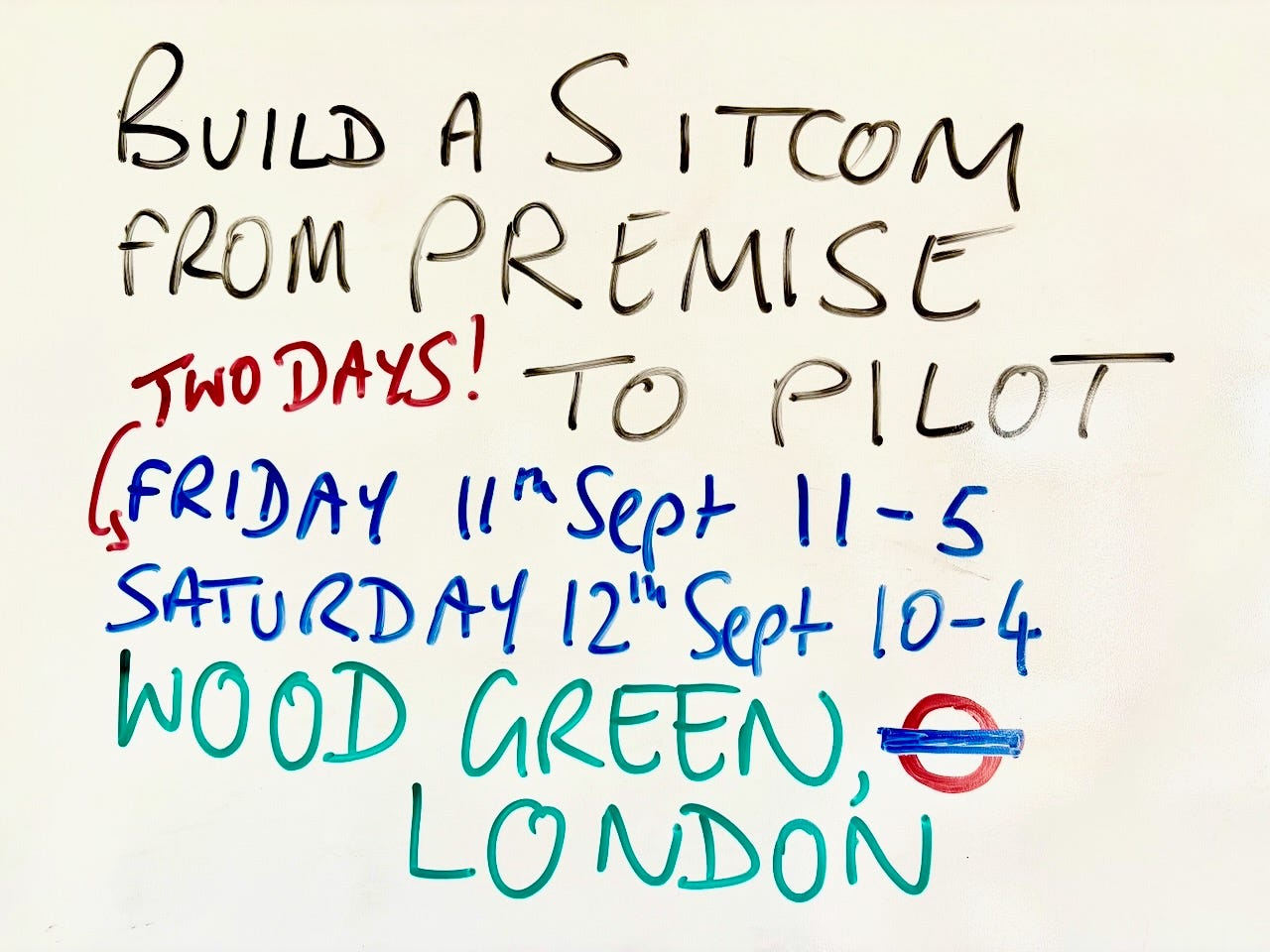
Would you like to spend TWO DAYS in a writers’ room with me and a bunch of other writers, coming up with ideas, pitching stories, breaking them, turning them into plots and figuring out the pilot? You can do that on 11th-12th September in North London. Places are limited, so I recommend booking early.
I’ve also made a new YouTube video which you can watch HERE, or read below:
The sixth P in the Sitcom Engine—and a practical way to generate enough stories to find the one your pilot deserves.
You’ve got a plot for your sitcom pilot.
But have you?
Are you sure it’s the plot that best introduces the premise, the precinct and the personalities? Or, more likely, is it simply the first plot you thought of?
This is where many pilot scripts go wrong. They contain funny characters, good jokes and even some excellent scenes. But they begin with the wrong plot. Gah!
Either nothing much is happening, or the wrong thing is happening.
The sitcom is dead on arrival.
Fortunately, there is a way to avoid this: choose a better plot.
And the best way to choose a better plot is to have lots of plots to choose from.
Not three. Not five. Ideally, you want a shortlist of twenty juicy possibilities. To get those twenty, we’re going to begin with a much longer list.
A hundred ideas.
Don’t panic. I’ll show you how.
Your pilot is not the whole story
Before we start generating ideas, let’s be clear about what we’re trying to create.
A sitcom is not one enormous story divided into instalments. It is a precinct: a place, situation or community that can keep producing new stories. It is a permanent second act—an arrangement that could potentially run for a hundred episodes and make you, along with several other people, millionaires.

This is why I developed my Sitcom Engine: ten elements beginning with P, distilled from 25 years of writing sitcoms for the BBC. This is the sixth P: Plot.
A sitcom needs a generous supply of future plots. You’ll need them for your treatment, outline or show bible, because commissioners and producers want to know that the idea can run and run.
But you also need lots of plots right now.
Far more than you think.
Your sitcom will initially be judged on its pilot, so you need to find the plot that demonstrates the show at its best. Choosing the right one will also make the pilot much easier to write. Imagine that: writing a script becoming easier!
Perhaps your pilot feels difficult because, somewhere beneath the surface, you know something is wrong. You may be clinging to an unsuitable plot simply because it’s the only one you have. You are attempting to hammer a square peg into a round hole.
So let’s find some more pegs. One that will fit nicely.
The brilliantly typical plot
The ideal pilot plot demonstrates the premise of the sitcom. It tells the reader, producer or viewer why this world is funny—and why they will want to return to it.
It should be brilliantly typical.
Not merely dramatic, or just the wildest story that could ever happen to these characters. It should feel like a particularly good example of the sort of story this sitcom naturally produces.
Of course, “come up with the perfect plot” is useless advice.
I can’t reliably think of the perfect plot, and I’ve been doing this for 25 years.
So do what I do: cheat.
I generate loads of plots and choose the best one.
The aim is to find twenty juicy possibilities hidden inside a larger list of a hundred rough ideas.
You do not need to develop all hundred. At this stage, each can be a single line, plus anything else that immediately leaps into your mind.
Don’t worry about which character belongs in which story. Don’t get bogged down in structure. The idea doesn’t even need to be the beginning of an episode.
It could be:
an inciting incident;
a misunderstanding;
a revelation;
a deadline;
a disaster;
an obstacle;
a midpoint;
a finale;
a final image;
or simply an intriguing event or concept.
Don’t look for complete episode ideas yet. Look for moments.
Six ways to generate 100 plot ideas
1. Research the world
Talk to people who do what your characters do. Search online. Read trade magazines, specialist forums, newsletters and professional publications.
This is one task AI can be genuinely useful for, especially if you ask for specific information about an industry rather than requesting “plots for a sitcom set in that industry”.
But nothing beats talking to people who actually inhabit the world you are writing about.
If you are a teacher writing a school sitcom, that gives you an excellent starting point, but talk to other teachers too. Speak to people at different schools, in different roles and at different stages of their careers.
You are looking for frustrations, rituals, rivalries, rules, jargon, crises and peculiarities. Anything that could produce comic pressure.
2. Mine life events
Make a list of the things that happen during an ordinary day: getting up, brushing your teeth, having breakfast, travelling to work, arriving late, losing your keys.
Any one of them might trigger an idea.
Then widen the lens. Think about the things that happen over the course of a year: traditions, holidays, family gatherings, annual inspections and community rituals.
Look for landmarks and milestones:
a first day at school;
a driving test;
a retirement party;
a wedding anniversary;
having your driving licence taken away because you are no longer safe behind the wheel.
Birthdays can be useful, although they force you to give a character a specific age, which may create complications later.
Go through your diary. Look through old photographs. Think about rites of passage, repeated rituals and events unique to your family, workplace or community.

3. Examine the zeitgeist
What is currently floating around in the culture?
Look at social media. Or, better, buy a physical newspaper, sit and read it. Make notes. Think about current affairs, technological changes, new patterns of behaviour and words that barely existed a decade ago.
How are your characters affected by these changes?
What are they struggling to understand? What are they pretending to understand? Which new rules or expectations are they resisting? What has suddenly become unacceptable—or unavoidable?
Keep it simple. You are making a list, not writing the episode.

4. Keep a notebook
Use a physical notebook or the notes app on your phone to capture fragments from everyday life.
A strange remark. An awkward encounter. A petty argument. Something that happened to a friend. Something you saw on the bus. A rule that makes no sense.
Record these moments before you forget them.
This is not merely an exercise for today. Make it a habit. Start building your own private reservoir of comic situations.
Begin now.
5. Steal from the classics
Take story ideas from Shakespeare, the Bible, Greek mythology, classic literature and great films.
Could your sitcom produce its own version of The Prince, Dante’s Inferno or Pride and Prejudice?
You are not copying the original story. You are borrowing a useful dramatic pattern: jealousy, betrayal, forbidden love, pride, temptation, rivalry or a disastrous attempt to gain power.
WARNING: avoid movie parodies and elaborate homages.
Don’t force your characters to embark on a quest simply because it will remind the audience of a famous film. That will feel derivative, and it forces the characters to follow someone else’s narrative rather than behaving according to their own personalities.
Save that for Series Seven, when everyone has run out of ideas.
6. Work from A to Z
Finally, use sheer grunt work.
Write the alphabet down the side of a page and generate ideas beginning with each letter.
A could suggest an audit, an anniversary or an accusation. B might produce a bet, a burglary or a breakdown. Keep going until you reach Z.
Do it in a café with a notebook. Stay there until you have something beside every letter.
This method is not glamorous, but glamour is overrated. You need material.
Don’t wait for perfection
The purpose of this stage is to generate starting points. You are not deciding which ideas are good. You are certainly not trying to write all of them. You are collecting possibilities.
Use abandoned ideas from other sitcoms or dramas. Adapt incidents from your own life. Grab material from anywhere.
Have you reached a hundred?
Good.
Now squeeze out another fifty. Go on.
The obvious ideas often arrive first. The stranger, more distinctive ones may only appear after you feel you have exhausted the supply. Keep going just a little bit longer.
Stage two: find the juicy ones

Once you have your enormous list of 100+ ideas, read through it.
Whenever an idea makes you smile, stop and give it a little more attention. Expand the single line into two or three sentences. Ask how it might fit the particular world of your sitcom.
Some possibilities will immediately feel more alive than others. They will suggest complications, character conflicts and comic consequences. They will feel juicy.
Choose around twenty of those.
There they are: the twenty juicy plots that I promised you.
Now put the list aside.
Let the ideas sit in your mind for a while. When you return, you will be ready to test them against your premise, your characters and the distinctive comic engine of your show and, eventually, to choose the plot that deserves to become your pilot. But we’ll get on that. Right now, you’ve got homework to do.
Subscribe to make sure you receive the next instalment. It’s free!
And why not explore the Situation Room archive for more advice on writing sitcoms?