
What Sitcom Writers can learn from Scrooge
Plus some extended good will

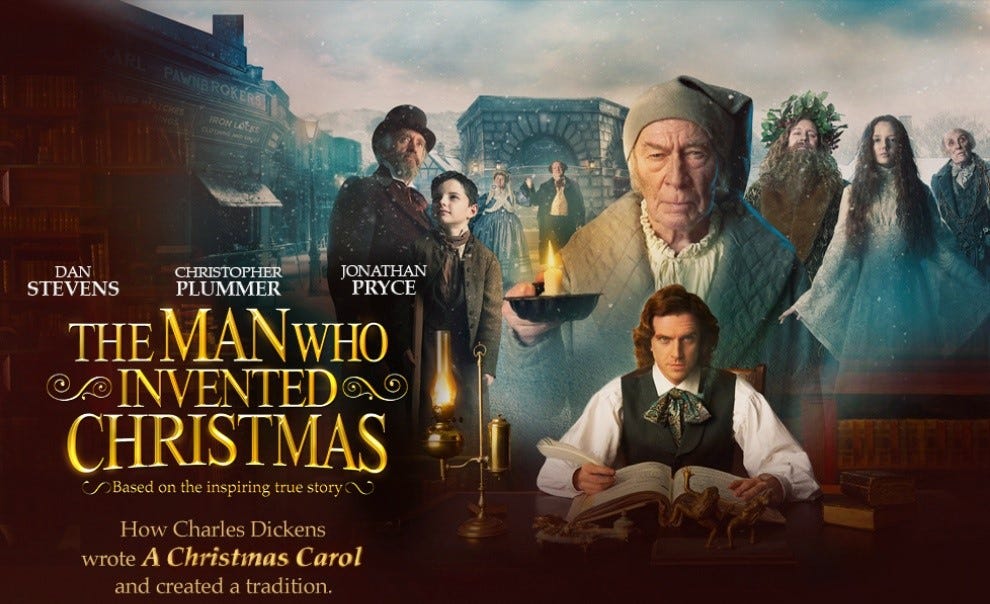
Ebenezer Scrooge has to be one of the great fictional characters. Reprised so many times in so many ways, the standard Christmas story – and sitcom Christmas special – of the overnight miracle and transformation is in no small part down to A Christmas Carol by Charles Dickens. This was a tale written by a hard-up writer, desperate for money. The story of the writing of the book itself is a good one. On that score, I heartily recommend the 2017 movie, The Man Who Invented Christmas.
Scrooge is a miser who loves money. It must have pained him that his name, Ebenezer Scrooge, had so many letters — since a shorter name would have cost him less ink whenever he had to write his name. Scrooge loves money.
I often say that money is a poor motivator in a sitcom. I contend that nobody actually wants money for its own sake. There’s always a reason: to buy status, control or security. Even for the super-rich, money is either a way of keeping score against other billionaires or controlling people. It’s never about the money.
Money is petrol on a flame. It is an accelerant. Money gives people their heart’s desire. It takes off the limitations, meaning they can have their heart’s desire. And through that we can see what their heart truly desires. Is it ever money for its own sake?
Exceptional Scrooge?
Is Scrooge the exception? He is, after all, an exceptional and extreme character. In a sense, he’s a brilliant sitcom character where everything is turned up to eleven. His speech is harsh, graceless and cruel about the poor and the needy. He makes his clerk work in the freezing cold and begrudges granting him a day off for Christmas. He also has some excellent lines. I highly recommend the version on Audible read by Hugh Grant, who is brilliant when reading the awful things Scrooge says.
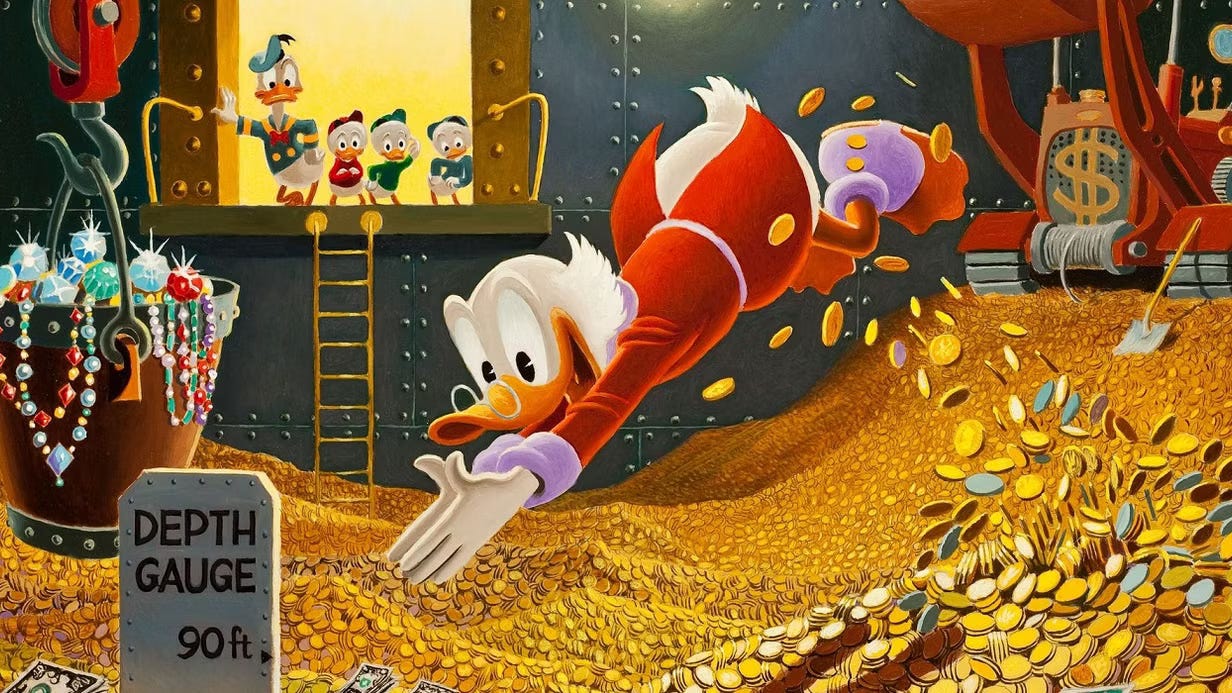
But is Scrooge motivated by money itself? He does not go home and count it. That’s Scrooge McDuck who, in the opening titles, dives into a pool of gold coins. After his day’s work:
Scrooge took his melancholy dinner in his usual melancholy tavern; and having read all the newspapers, and beguiled the rest of the evening with his banker’s-book, went home to bed.
His house is spartan, devoid of luxury. There are no signs of wealth. Why not? Because he has self-control. That, for him, is the supreme virtue. Going without. Self-denial. He has money, but doesn’t spend it. And he has nothing but contempt for those who make him rich, who come to him to borrow money. He disparages them and despises them with gleeful loathing. Because he can go without. And they cannot.
I tried looking for more quotations to justify my theory, but didn’t find a slam-dunk line. What do you think? Good theory? Leave a comment below.
In a way, Dickens did not need to wrestle with this very hard. This is a story of transformation. A Christmas Carol is a novel and a movie, not a sitcom. But I’d love to see a sitcom based on this character. Blackadder’s Christmas Carol gives us a sense of that. I’m sure we’d all love to watch a whole episode – or series – in which Blackadder is a Scrooge!
What’s the Lesson?
We can learn a couple of things here as sitcom writers. The first is that Scrooge is a brilliant comedy character who oozes character from every pore. We are in no doubt about him and his motivations, even if they are slightly murky. He is a larger-than-life character. How can the key characters in your sitcom be larger-than-life and turned up to eleven?
And the second lesson is for me: in the spirit of Christmas cheer rather than Black Friday, let’s extend that deal till the end of the week. That’s because my real motivation is to help you write a better sitcom script. I’ve never met you so I can’t pretend to love you. But I do love sitcoms and I do want there to be more of them. And I want them to be better. So we all laugh more. And there are more sitcoms. And 14 Problems with your Sitcom Script will, in a very small way, help that happen.
So let’s keep that Black Friday offer running a little longer, shall we? Till the end of the week. 14 Problems with your Sitcom Script PDF & Webinar Replay. Use code: BLACK14 for a 50% discount. Offer closes end of Friday 5th December 2025. Go on. Go on.
The next day,. I’ll be at the Comedy Conference in London talking about how to actually write your sitcom script! See you there?

I really ought to watch The Man Who Invented Christmas - it's written by Susan Coyne, who was coauthor of the excellent not-quite-a-sitcom Slings and Arrows!